
Energy, infrastructure and savings: the data behind the Qudwatt thesis.
The Observatory brings together public data that helps explain Morocco’s energy transformation: demand growth, capacity requirements, announced investment and the depth of domestic savings. The objective is not to replace existing sources of finance, but to document the case for a complementary channel connecting part of those savings with the Kingdom’s strategic infrastructure.
Royal guidance
Finance the transformation with more domestic resources
In the Throne Day Speech of 29 July 2026, His Majesty King Mohammed VI called on the financial sector to broaden access to financing in qualitative terms and to become more open and innovative in order to optimise the mobilisation of national savings. This direction directly echoes the logic Qudwatt is seeking to embody.
Maroc.ma · 29 July 2026Key takeaways
Morocco’s electricity consumption is accelerating: +7,3 % in 2025, compared with 3.9% the previous year.
To meet that demand, the power fleet must almost double: +11,6 GW to be built by 2030.
The public utility states that 72 % of this programme will need to be financed by the private sector.
Demand
A country that equips itself consumes more
Why electricity consumption is becoming one of the clearest indicators of the Kingdom’s economic transformation.
Electricity demand is rising because the economy is changing: new industrial activity, desalination, household equipment and the electrification of uses are creating additional, lasting needs.
This momentum is positive, but it requires an immediate response: generate more power, reinforce the grid and finance new infrastructure capable of supporting this increase in demand.
This increase is not merely a consumption statistic. It reflects a structural change in the economy: more industry, more equipment, greater electrification of uses and, above all, the emergence of activities that consume large amounts of energy continuously.
Desalination illustrates this shift clearly. Producing drinking water from seawater helps address water stress, but it also creates new electricity demand. The more the country develops this infrastructure, the more energy policy becomes inseparable from industrial policy, water policy and territorial planning.
For an investor, this dynamic is essential to understand: energy infrastructure never exists in isolation. Its value depends on the need it serves, the grid it connects to and the economy’s long-term ability to absorb the energy produced.
Growth in electricity demand in 2025.
New uses make the increase structural.
Generation, grid and flexibility must keep pace.
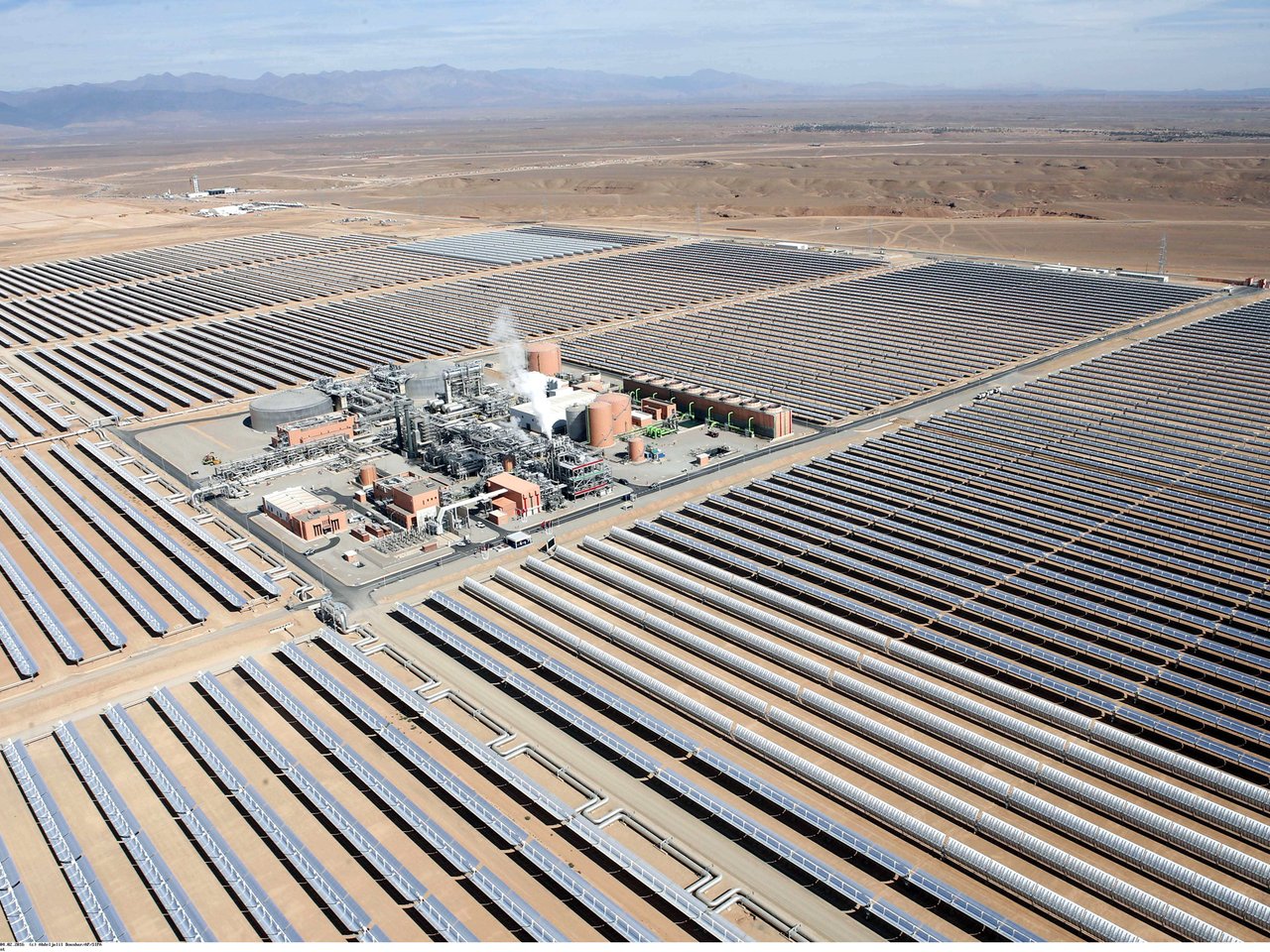
Solar asset · Ouarzazate
NOOR Ouarzazate: the scale of national energy infrastructure.
The solar complex embodies one of the transition’s most visible dimensions: large-scale assets rooted in their territory and designed to operate for decades.
Photo / source: Jeune Afrique ↗The public response
The power fleet must almost double
The public response is now quantified: renewable capacity, storage and grid investment provide a much clearer trajectory through 2030.
Morocco is entering a phase in which the transition is no longer simply about installing solar panels or wind turbines. The entire system must be considered: generation, storage, grid connection and the network’s capacity to absorb new flows.
Recent public plans above all show a change of scale. This visibility makes financing needs easier to assess and is creating a genuine universe of energy assets.
The public response shows that Morocco is no longer thinking project by project. Targets for new capacity, storage and grid reinforcement now form a full infrastructure programme in their own right.
This fundamentally changes how the sector should be read. Building more solar or wind capacity also requires the ability to store part of that output, transport it to centres of demand and secure the system when renewable generation fluctuates.
The +11.6 GW figure should therefore be seen as the visible tip of a broader requirement: behind the power plants themselves are substations, transmission lines, batteries, hydraulic assets, industrial equipment and new power-purchase agreements.
Renewable capacity the grid could accommodate by 2030.
Order of magnitude of the 2026–2030 investment programme.
New storage capacity announced.

Wind · Renewable generation
Wind complements solar with a different generation profile.
Regular wind regimes across several Moroccan regions help diversify the energy mix and spread generation across different hours of the day.
Financing
The missing link is not technical
The challenge is not to replace existing financiers, but to broaden the pool of capital able to support projects.
Banks, institutional investors, public-sector actors and international partners already finance the Kingdom’s major projects. The issue is therefore the scale and diversification of available capital.
Qudwatt explores a complementary channel: connecting part of Moroccan and diaspora savings with identified productive assets through a clear, regulated investment framework.
Financing this transformation already relies on a strong ecosystem: Moroccan banks, institutional investors, public operators, private developers and international development financiers. Qudwatt therefore does not start from the assumption that Morocco lacks financiers.
The question is different: when investment requirements move to a new scale, can the sources of capital also be diversified? Household savings are currently concentrated overwhelmingly in bank deposits and traditional products. Subject to an appropriate framework, part of these savings could be directed towards identifiable productive assets.
Such a channel would only make sense if it remained complementary to bank and institutional financing. The role of a platform or dedicated vehicle would therefore be less about replacing banks than about making certain investment tranches accessible, understandable and properly governed.
Share of the 2026–2030 plan expected to be financed by the private sector.
Order of magnitude of household bank deposits.
A bridge between savings and productive investment.

Grid · Power transmission
Generating more is not enough: power must also be transmitted and connected.
The grid connects new generation areas with centres of demand. Reinforcing it is therefore a direct condition for accelerating the energy transition.
What can be concluded
Morocco is already financing its transition. The question is how to broaden its capital base.
Taken separately, each of these figures tells part of the story. Taken together, they point to a much simpler thesis: Morocco is entering a phase in which energy is becoming infrastructure for growth, and the ability to mobilise capital is becoming as important as the ability to build.
The overall picture is clear: electricity demand is accelerating, the capacity to be built has been identified, and major public, banking, institutional and international financiers are already mobilised around the Kingdom’s energy transformation.
The next challenge is therefore not to replace these actors, but gradually to broaden the pool of available capital. Within an appropriate framework, part of domestic and diaspora savings could complement existing financing and participate in identifiable productive assets.
This approach nevertheless requires genuine selection and investor education: understanding the asset, its sponsor, its contracts, its economic cash flows, its risk level and the investor’s exact position in the financing structure.
That is precisely the hypothesis explored by Qudwatt: creating a clear bridge between abundant savings and strategic infrastructure, without setting institutional finance against individual investment.
A logic of complementarity, not substitution.
Appendices
Reference data & sources
The Observatory prioritises an editorial and educational reading. The tables below retain the main figures and source links so readers can distinguish the narrative, the orders of magnitude and the underlying references.
Demand, mix & new uses
| 92 % | Share of needs covered by domestic generation2025 | EcoActu ↗ |
| 58 % | Coal share of generation2025 | AIE ↗ |
| 2 539 GWh | Imports from Spain, 5.5% of demand2024 | ANRE ↗ |
| 1 % → 5 % | Desalination share of consumption, 2024 then 20302026 | EcoActu ↗ |
| 5 GW | Green electricity reserved for industry by 2030Nov. 2025 | State · ONEE · Masen ↗ |
Investment programme
| 10 429 MW | Grid hosting capacity for renewables, 2026–2030Jan. 2026 | ANRE ↗ |
| 248 Md MAD | ONEE investment plan, including 206 for electricityJul. 2026 | ONEE ↗ |
| +11,6 GW | Additional renewable capacity planned2026 | ONEE ↗ |
| +2,6 GW | Storage capacity planned2026 | ONEE ↗ |
| 12,2 GW | Total installed generation capacity2025 | Ministry ↗ |
| 46,1 % | Renewable share of installed capacityend-2025 | ONEE ↗ |
| ≈3 GW | Projects authorised in the first quarterQ1 2026 | Ministry ↗ |
| 78 Md MAD | Regional multi-service company plan2026 | Team France Export ↗ |
| 1,21 / 0,94 | Average production cost and selling price, MAD/kWh2022 | Tariff analysis ↗ |
Savings and financing
| 72 % | Share of plan to be financed privatelyJul. 2026 | ONEE ↗ |
| 1 030 Md MAD | Household bank depositsJun. 2026 | Bank Al-Maghrib ↗ |
| 233 Md MAD | Share held by Moroccans living abroadJun. 2026 | Bank Al-Maghrib ↗ |
| 1 422 Md MAD | Total outstanding bank depositsJun. 2026 | Bank Al-Maghrib ↗ |
| ≈130 Md MAD | Gap between deposits collected and loans distributedMar. 2026 | Bank Al-Maghrib ↗ |
| 1,82 % | Minimum passbook savings rate, second half2026 | Bank Al-Maghrib ↗ |
| 2,16 / 2,60 % | Term-deposit rates, 6 and 12 monthsMay 2026 | Bank Al-Maghrib ↗ |
| 22 Md MAD | Investment represented by projects authorised in Q12026 | Ministry ↗ |
| 2/3 | Target share for private investment by 20352026 | National Pact ↗ |
| 29/07/2026 | Royal call to mobilise national savings2026 | Maroc.ma · Médias24 ↗ |